
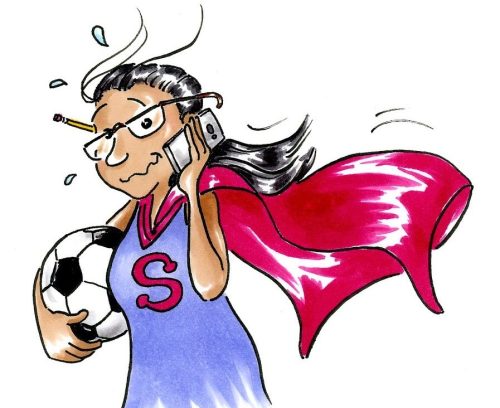
For most women, the onset of perimenopause comes without much warning. When it began for me, I was your typical, modern-day woman: a working wife and mother, the classic soccer mom, a short-order cook, an all-around superhero, and a HOT, soaking mess—literally! With all the advances in women’s health and wellness, I wondered how I stumbled into perimenopause without knowing what it was, how it would affect me, or where I could find some relief!
Goodness knows I needed it. Night after night, I found myself wide awake and soaking wet. Unable to fall back asleep, I’d lay in the dark, struggling to make sense of it all. Like why was I losing the hair on my head while a goatee grew on my chin? Or when did my once flat stomach swap places with my big, fat butt? And what had I done in life to deserve vaginal dryness and a leaky bladder? To make matters worse were my frequent bouts of anxiety together with my daily crying jags and fits of rage—all of which had everyone convinced I went off the deep end.
Little did I know I was in the throes of perimenopause, that inevitable but rarely talked about period in a woman’s life when our menstrual cycle becomes less regular, our estrogen levels plummet, and our lives go into a tailspin. But don’t get me wrong; it’s not like I’ve never heard of menopause before. Almost everyone’s heard about those infamous hot flashes and dreaded night sweats, and nearly everyone recognizes them as the defining symptoms of “the change.” Now perimenopause, that’s another story altogether!
Hallmark Symptoms
Who knew that long before a woman hit menopause, she would first enter a transitional period lasting anywhere from 4-8 years—or even longer? This period is called perimenopause, and although it’s typically the most intense and tumultuous phase of menopause, it’s generally the least understood.
Fortunately, after facing a series of unsettling changes in her own body and realizing she was smack-dab in the middle of perimenopause, Dr. Ann Louise Gittleman, a top nutritionist and women’s health advocate, made it her “mission to enlighten women everywhere between the ages of thirty-five and fifty about this newly recognized stage of life called perimenopause.”
In her pioneering work Before the Change: Taking Charge of Your Perimenopause, Dr. Gittleman demystifies what has long been a taboo topic and brings attention to the more than 45 symptoms women may experience during perimenopause. Here are some of the most common:
Fatigue
Heart Palpitations
Irritability
Joint Pain
Low Libido
Migraines
Urinary Incontinence
Vaginal Dryness
An Inevitable & Familiar Journey
Although my symptoms caught me by surprise, oddly enough, perimenopause was not an unfamiliar experience. In her groundbreaking book The Wisdom of Menopause, Dr. Christiane Northrop explains that women pick up at perimenopause where they left off at puberty. When you think about it, the same “hormonal shifts” that make our lives miserable in perimenopause are not unlike the “raging hormones” that tortured us as teens. The most notable difference, however, is that our journey through perimenopause does not enjoy the same level of attention or support as our transition through adolescence.
Here’s what I mean. As a teenager, I had the worst ever PMS, but I also had a host of remedies at my disposal, from Pamprin to Midol to advances in menstrual hygiene that took us from the super-complicated sanitary napkin and belt to the super-absorbent maxi pad with wings. And let’s not forget the most important thing of all—tons of information that came in the form of a middle school health class. There we sat on the edge of our seats, eyes wide open and full of giggles as we learned about our ever-changing bodies and the wonders of human sexuality.
As embarrassing as sex education may have been, at least our journey through adolescence was an informed experience and one that’s been recognized as a distinct stage of life since the early 1900s. In fact, in The Happiness Curve: Why Life Gets Better After 50, Jonathan Rauch reminds us that “the concept of adolescence is so firmly rooted in our culture that we can’t imagine life without it.” What’s particularly important, he adds, is that we have a “narrative for adolescence: a story in which the challenges and difficulties of the teenage years are part of a normal transition.”
Well, even though perimenopause is as normal a transition as adolescence, you’d be hard-pressed to find any specialized classes for us middle-aged girls. Instead, we continue to face the challenges of midlife in relative isolation, navigating the inevitable without the benefit of a narrative or a safe space to share it. Equally troubling is the lack of progress in menopause care and the ongoing controversy surrounding the safety of hormone replacement therapy (HRT).
In Why We Can’t Sleep: Women’s New Midlife Crisis, Ada Calhoun highlights the sad irony that while experts agree HRT remains the single most effective and scientifically proven treatment for perimenopause, lingering uncertainty regarding HRT and the increased risk of cancer, stroke, and blood clots continue to play into the confusion and sense of isolation women already feel during perimenopause.
You Are Not Alone: Sharing Our Story
But the fact of the matter is that you’re not alone. Women make up more than 50% of our nation’s population and over half are between the ages of 40-59, which means most of us are either entering perimenopause, in the thick of it, or coming out the other side. And let’s say you’re one of the lucky ones who may never experience any symptoms, you likely won’t escape the myriad of other issues that crop up in the middle years. Whether it’s the rebellious teen, ailing parents, a lonely marriage, or thankless job, most women are bombarded with a series of typical midlife challenges, all while coming to terms with the fact that we’re not getting any younger.
Yep! On top of everything else, signs of aging become more apparent at this time in our lives, and whether we care to admit it or not, growing old in a society that reveres the young and renders us invisible sets us up for another painful letdown. No matter how progressive we think we are, when those lingering glances and once-annoying catcalls stop coming, trust me, we take notice. What’s even more disturbing are the more blatant forms of ageism, like being passed up for a job even though our years of experience eclipse the younger, less credentialed candidate, or the times we’re ignored in a conversation or excluded from the very circles we once ran in.
While these experiences can make for a lonely passage into the second half of our lives, the good news is that we share them with countless other women, many of whom have fought the good fight and lived to tell the story. And at the end of the day, it’s the story that unites and makes us stronger. I can’t tell you how often I felt like I was sinking in quicksand until a story became my lifeline. When one of the older ladies at work assured me I wasn’t going crazy but that my out-of-control mood swings sounded exactly like what she went through during the “change,” I hugged her so hard I nearly knocked her to the floor.
It’s no different from the time an acquaintance of mine pulled me aside at a cocktail party and confided that before seeing her gynecologist, having sex with her husband was about as much fun as getting a rug burn. Hearing I wasn’t alone in my struggles with vaginal dryness was like music to my ears. And how can I forget my secret fear of bleeding to death until one of my closest friends told me she too experienced monsoon-like gushes at an age when we thought our periods should be wrapping up. Hers got so bad that despite doubling her maxi pads, wearing a tampon and a pair of pantyhose, one day while racing to a business meeting, a blood clot found its way out of her crotch, down her leg, and into her shoe!
These, my friends, were the kind of stories that kept me afloat, that normalized my journey through perimenopause and gave me the strength I needed to push through. Although my experiences weren’t always the same as other women, more often than not, we still shared the same level of frustration—a sense that our mental acuities and physical bodies had betrayed us, along with the sinking feeling that despite a lifetime of putting everyone else’s needs before our own, we were left to fend for ourselves at a time when we needed support and understanding the most.
Is It A Crisis or A Comeback?
But hot flashes and blood clots notwithstanding, my journey through perimenopause amounted to more than just a royal pain in the ass. For me, it was a turning point—a time of deep reflection in which the loss of my fertility, the onset of the aging process, and the weight of every midlife struggle made me question: Is this the stuff of a midlife crisis or a golden opportunity to make…a comeback?
You see, midlife may have had me down, but something inside refused to let it count me out. I couldn’t imagine that the best years of my life were behind me or that all the trials and tribulations I had endured thus far served no greater good. At the same time, I wondered if I was foolish to hope for better days ahead or better off resigning myself to an inevitable downward spiral.
My search for an answer to that question led me to an emerging body of research that flipped the script on popular opinion and helped reframe my outlook on life. In Life Reimagined: The Science, Art, and Opportunity of Midlife, Barbara Bradley Hagerty not only makes the startling claim that there’s very little evidence to support the existence of a midlife crisis, but that midlife presents us with “far more choices than a midlife-crisis culture would lead us to believe.”
After talking to countless people, from brain scientists to ordinary middle-aged folk, she found that in spite of the very real hardships that befall us during middle age, an overwhelming number of people described midlife as their golden years, a period in which they weathered a series of storms only to gain a renewed appreciation for what mattered most in life, such as building relationships, finding a deeper purpose, and reimagining the way they see themselves in the world. Much like my instincts told me, life didn’t have to go downhill in midlife. Instead, her research strongly suggests it can be a time of unprecedented growth and unexpected joy.
In much the same way, Susan Mattern’s The Slow Moon Climbs: The Science, History, and Meaning of Menopause chronicles the changing attitudes toward menopause and not unlike the bum rap midlife’s gotten, Mattern believes modern society has it all wrong about menopause, too! While she can’t pinpoint the exact reasons why menopause landed its historically bad reputation, she is crystal clear on its ultimate purpose. According to Mattern, women, unlike most mammals, are naturally selected to outlive their reproductive years—and for good reason. Simply put, “we become non-reproductive so that we can do other things.”
How ‘bout that!
It never occurred to me that the menopausal transition paved the way for a richer, far more rewarding time in life when the loss of my fertility would make me fruitful in ways I never imagined. Think about it. Childbearing years behind me, an empty nest on the horizon, and a ton of life experiences under my belt, this chapter of life came with a sense of opportunity more inviting than the reckless abandon of my youth. And this time out, I had no illusions about life. If nothing else, I learned three simple truths: Life is short. Often sucks. And marches on with or without us. So, I could either stay stuck in my largely unsupported midlife crisis or, as Mattern would advise, start doing other things.
Doing Other Things
I chose to do other things. That didn’t mean it was easy, or I wouldn’t ruffle some feathers along the way. It just meant I made up my mind to embrace the untold opportunities awaiting me in life’s second act. And how grateful to know I wasn’t having a midlife crisis but muddling through a very typical midlife malaise—that in-between place where I realized what once made me feel successful no longer mattered and my newfound sense of accomplishment, the other things, had yet to be determined.
Good thing figuring that out didn’t take as long as I thought it would. One of the other things I did right off the bat was drop my filter. While it’s true I’ve never been a shrinking violet, the difference now is that I no longer second-guess myself or make apologies for speaking my mind. These days I say what I mean and mean what I say, and I can’t tell you how good it feels—the Mr. Vice-President, I’m speaking kind of feel-good that calls folks out and shuts them down when they try to bully you into silence.
I also don’t do what I don’t feel like doing anymore. Prioritizing everyone else’s needs was a burden I learned to remedy with a few simple fixes: Do I take on extra projects at work to impress folks who don’t value me anyway? Ah, nope. Am I solving your problems at the expense of my life being in shambles? Don’t think so! Will I continue to let your bad day ruin mine and rob me of my joy? The answer is no! And in case you didn’t hear me, I said: N-O, leave-me-be, and middle finger to ya!
But the other thing that’s truly given my life new meaning, that’s made me rethink who I am and in the spirit of Michelle Obama, who I am becoming—is sharing my midlife journey. Often messy, occasionally funny, and not always easy to tell, my story is not unlike so many middle-aged women who find themselves fighting for their rightful place in a world that still counts us out. In the midst of the struggle, I found refuge in my nightly journal turned daily blog—a safe space for us middle-aged women to pour out our hearts, lick our wounds, and mount our comeback stories.
As Michelle Obama so eloquently reminds us, “there is power in allowing yourself to be known and heard, in owning your unique story, in using your authentic voice. And there’s grace in being willing to know and hear others.” In the end, this is how we continually become our better selves, how we keep doing other things, and how we make this inevitable journey worthwhile.
ILLUSTRATION: JOANA MIRANDA
Extremely well written, thoughtful, and inspiring–all at the same time! Can’t wait to read more content from this blogger!
I can’t thank you enough for your well wishes, Elizabeth! Looking forward to you coming back for more!
Girl…..you took me on a journey!
Ain’t that something how in a blink of an eye…things as we know it change! Physically, mentally, emotionally, and even spiritually. At times your article had me laughing because it’s so relatable! (I get it!!!)
Cheers as we rise up and embrace our journey!
You’re so right, Kimberly. It’s so important that we embrace this journey. No matter how challenging it is at times, I can assure you, there are better days ahead.